Showing posts with label Politics রাজনীতি. Show all posts

Monday, January 16, 2012

Why turn Indira Bhavan into Nazrul Bhavan?


Indira Bhavan- Nazrul Bhavan
Indira Bhavan, Kolkata
The decision of the West Bengal state Chief Minister, Mamata Banerjee to turn Indira Bhavan into "Nazrul Bhawan" needs to be reconsidered. I loved her earlier decision to setup Kazi Nazrul Research Centre because previous governments had not done enough to commemorate Nazrul, whose literary works, partiotic spirits and lyrical compositions were praised throughout the country. 

The ongoing controversy on the renaming issue had raised everyone's eyebrows and made us thing that why was it necessary to rename Indira Bhavan and house the Nazrul Academy and museum in it and whether this is a right decision to do so. We know that West Bengal doesn't have a permanent Chief Ministers house which hampers the image of "Brand Bengal", so Indira Bhavan could have been turned into the chief ministers residence instead avoiding all the unnecessary controversy.

The question now arises is that: 
Why turn Indira Bhavan into Nazrul Bhavan?
  • This is undoubtedly an unwanted and unnecessary move to turn Indira Bhavan into Nazrul Bhavan. The building has its own history intact and it's totally unfair to play with it. How can the present government change the name of a Historical Building? Its's nothing more than political game-play.
  • On the other hand, its shameful that the government wants to dedicate an old and used building for Kavi Nazrul. Its disgraceful to house the Nazrul Research Centre in this old two storey building. Its a matter of shame for us, the Bengali community of West Bengal that- our leaders are now more interested in playing politics instead of doing something constructive. 
  • Why not construct a brand new modern building dedicated to our beloved rebel poet Kavi Nazrul Islam? It would be a matter of pride for the entire Bengali community. We can boast of having a modern structure equipped with all modern amenities and have an architectural design that will suit the purpose of the building. 
In the midst of this name change controversy, Nazrul kin- Misti Kazi expressed her grief saying,"Thre is no reason for such controversies. It pains us to see such debates over Kazi Nazrul Islam who is a world poet." 


Peace and Development of Bengal is all we need.

Tuesday, December 20, 2011

West Bengal needs 51% FDI in retail


51% Foreign Direct Investment (FDI) in multi-brand retail is the need of the hour in India and particularly in West Bengal. Presently FDI is not allowed in Multi-Brand Retailing in India. Whereas it should not only be permitted but also highly encouraged because it will surely benefit the producers (farmers) and the consumers. I’ll discuss it further in this article.

Another Historical Blunder in the making!
Mamata Bannerjee’s strong opposition to 51% Foreign Direct Investment (FDI) in retail is like the opposition to computerization by the Communists in the 1960’s- 1970’s and that’s why this opposition is really hard to digest. Opposing the central government just for the sake of opposing is not-at-all a constructive movement for the future of West Bengal. West Bengal is lagging decades behind the progressive states like Gujarat, Maharashtra and Karnataka in almost every aspect – Apart from Kolkata there’s no other city which was developed in the past 60 years. We the people of West Bengal have unanimously voted Mamata didi into Power to get rid of the tyrannical communists and their ideologies thus, it’s high time that the state “Opens up” for new ideas and new investments wiping out words like “Cholche na- Cholbe na!” out of our dictionary!

Quick-look at the Present Retail scenario:
  • Crumbling Infrastructure: The logistics of the retail chain is still lying in the medieval age leading to inefficient supply of goods. The lack of cold storages in the country and the pathetic Public Distribution system leads to an annual wastage of about 30% fruitsand vegetables produced in India.
    Food Supply Chain Chart
  • Middlemen’s Domination: The middlemen buy produce from the farmers mostly on credit at slashed down prices. Then the produce passes through a series of an average five to six middlemen until it reaches the retailer. In this whole process profit margins of these middlemen plus the profit margin of the retailer hikes the price of the product up to three to four times the actual price. Ultimately the Farmers and the Consumers are the ones who are losing out the bargain. Many a times the middlemen and intermediary traders create false shortage of goods to shoot-up prices.


51% FDI in Multi-Brand retail is for the betterment of “Ma-Mati-Manush”:

  • FDI in retail sector will be very beneficial to the farmers. The farmers will earn profits directly and will get rid of the middlemen and thus they can modernize their farming techniques for better production. Thus, if the farmers benefit, they will sell the product at lower prices in the market this will further create a win-win situation for the farmers and the consumers by wiping out middlemen menace.
  • Organized retailing is at a nascent stage in India whereas 97% of retailing business is run by the unorganized retailers. The entry of retail giants like Wal-Mart, Tesco etc  in Indian retail market would create lakhs of jobs within five to six years. 
  • Another effect of allowing FDI in retail trade would be improvement in quality standards and consumer expectations as inflow of FDI will surely emphasize quality control and bring about competitive pricing. 
    Global Retail Giants
  • Opening up the doors for global retail giants will not only pump in the competition in the retail sector but will also help to establish a direct link between the farmers and the consumers thus, benefitting both. They would surely be interested to develop their own logistics which will be far better than the existing system thus reducing the amount of wastage. Thus, the end consumers will no longer have shell-out extra money for wastage and shortage of products.
  • Development of organized retail chain will boost the economy, greater GDP, greater tax collection and more employment and that too better paying employment. It will bring about advancement in agricultural techniques, supply chain improvement, tourism, greater sourcing from India. Thus, FDI should not be just allowed but encouraged.
Undoubtedly West Bengal is in a mess. We need better infrastructure which can be achieved by opening up routes for Foreign Direct Investment. FDI in retail is must for the benefit of the Farmers , the consumers and the Government. 

Thursday, November 24, 2011

Thumbs up for Anti-Maoist Drive


A Step towards Peace in Jungle Mahal or a Call for fierce & Violent attacks but definitely a huge setback for the Maoists. The 58-year-old top Maoist leader Koteswar Rao alias Kishenji was encountered by joint operational forces in a forest in West Midnapore district of Poschim Bongo (West Bengal).


The CRPF has confirmed that 207 Cobra Battalion, 184 CRPF battalion along with Bengal state police killed the top Maoist leader in a joint operation.

Union Home Secretary RK Singh said, "Our officers have told us that Kishenji has been killed. It's a huge setback for Maoists."

Maoists & Terrorists - Aren't they all same?
Now its time people should give a second thought about these Maoists - Are they any different from the Terrorists? 
The answer is straightaway "NO!".
  • The Maoists are the home-grown terror outfits formed to fight back against the callous handling of the tribals by the Government of India.
  • They took up arms for their rights in the mid 1960's. I believe the Government was and still is primarily responsible for their formation but the situation today is totally opposite.
  • They (Naxals) have killed and terrorized numerous of innocent people. 
  • They should return to mainstream... yes! but how long should we wait?
  • The train schedules passing through Naxal Affected areas have been changed since long.. but till date the Indian Railway is not confident about providing total security to these trains thus the train schedules have been yet unchanged - Causing great inconvenience for the passengers.
  • There are reports that the Maoists are being funded by External Sorces (Other Nations) - This cannot be tolerated at any cost.
Yes, We stand for Human Rights ! We want the Naxals (Maoists) to get back into the mainstream; but there's a limit for everything and they cannot go on killing and creating trouble for common people. If they do then they are no less than Terrorists. |Peace|


Sunday, September 4, 2011

Poschim Bongo!


The West Bengal state is the only state in India to have its name in ENGLISH!  Moreover the name is totally insignificant as discussed in my earlier post “Only BENGAL, not West Bengal! “. Almost everyone was taken aback by the West Bengal Government’s decision to rename the state as “Paschimbanga (read: Poschimbongo) পশ্চিমবঙ্গ”. Why were the people displeased? Because, West Bengal has been always referred as “Paschim Banga (read: Poschim Bongo) পশ্চিমবঙ্গ in Bangla, whereas it was known as “Paschim Bangal” in Hindi and several other languages and all of these meant “The western half of Bengal province”. So the question arises, what was the need to rename? When the meaning has remained the same?

The inhabitants of West Bengal expressed their desire to get rid of the “West or Poschim (পশ্চিম)” prefix but the politicians ignored it and unanimously decided to officially use the Bangla version of the state’s name i.e. Paschim Banga. This is absolutely a disagreeable name change; actually it’s not even a change!

Why don’t we support this change? Because,
  • It’s a cosmetic change, the meaning of the state’s name still remains unchanged i.e. it doesn’t satisfy the trivial purpose behind the demand for renaming. Apparently it seems like they changed the name just for the heck of it!
  • The renaming procedure will not be “free”, so when the government is ready to invest time and money in this name change procedure- it’s expected that this change is welcomed and accepted by the inhabitants of the state firstly! We don’t want the taxpayer’s money to be wasted if the renaming process if it is merely being translated!
  • There were better options like “Bongo Pradesh (বঙ্গ প্রদেশ)” or “Bangla Prodesh (বাংলা প্রদেশ)” or “Bharatia Bongo (ভারতীও বঙ্গ)” or “Bongo Bhumi (বঙ্গ ভুমি)” and people were ready to adopt any of these names but all they wanted is to shun the defunct “West পশ্চিম” prefix. We want the name of our state to be in Bangla, but the translation of the existing “West Bengal” is unacceptable!
  • Why is it taking so much time to provide our state a meaningful name ? There are several developmental issues that need immediate attention, so the Government should approve the public choice and start working for overall development of our state! 


The positioning of the state's name among the list of Indian States in the three cases : West Bengal (left), PaschimBanga (centre) and Bongo Prodesh (right).


Why did they do it? These could be the possible reasons: 

  • In order to standardize the name in all languages i.e. be it in English or Hindi or any other language, everyone is bound to use only “Paschim Banga”.
  • They wanted to keep the ghost of partition alive! They wanted that the state’s name should reflect that another half of Bengal lies across the border. But this issue could be resolved by naming the state “Bharatia Banga” or “Indian Bengal” this would have meant a change in reality..!
  • They might be showing us the hope for the futuristic “Greater Bengal বৃহৎ বাংলা” that is to form an United Bengal with Bangladesh J and free from Indian dominium.
  • Another concern was to bring the state position alphabetically higher in the list of Indian states for administrative reasons. Even then, by renaming as “Bongo Prodesh” or “Bangla Pradesh” or “Bharatia Banga” , the state would have featured in the 5th position in the list of Indian states; but “Paschim Banga” merely raises the state’s position to 22 on the list from being at the last position i.e. 28.
If they rename it Paschimbanga it will be nothing less than a waste of public money, waste of time, waste of resources, and most important undermining the sentiments of the residents of the state! 
জয় বাংলা ! Joy Bangla !

Wednesday, August 10, 2011

Only BENGAL, not West Bengal !


Since India's Independence in 1947, Western half of Bengal was integrated with India and was named as West Bengal though it had no Eastern half within the country's border ! East Bengal had then become a separate nation - which later proudly came to be known as the "Bangladesh" ("The Bengali Nation") in 1971. But, the Indian portion of Bengal was and is still being called "West Bengal".  But why ???


Why refer it as "West Bengal"? when there's no existing "East Bengal" in India?. Sounds completely illogical.... right?
To cut it short and make it simple- "West Bengal" doesn't make any sense today.... Think over it! its completely Irrational and illogical. We can never be "East Bengalis" or "West Bengalis"  We'r all just "Bengalis"  no matter we'r from East or West  - Its as simple as that ! The mere term "West" reminds us of the grim past and the sad memories of Partition of United Bengal. It also brings the debate of "Epar Bangalee and Opar Bangalee" Today the youth wants to be United and we have grown out of the "Epar Bangalee and Opar Bangalee" mindset, we want one identity that's being "Bengali".


In "Jana Gana Mana", India's national anthem, Rabindranath Tagore calls the land "Bongo (বঙ্গ )". In protest against the partition of Bengal in 1905, he had composed "Amar Shonar Bangla", thus referring to the land as "Bangla". The newly created country of Bangladesh adopted this song as its national anthem in 1972, but India and the Indian part of Bengal have failed to honor the spirit of his composition. It's high time we gave the state a name it deserves.


The time has arrived for giving a more meaningful and logical name to our state and to drop the prefix "West". But we also have to keep in mind that, by naming our state as just "Bengal"("Bongo" "বঙ্গ")  we would create a great conflict in our History and we cant afford to play with the heritage and history of Bengal! BENGAL is the Region of Bengali speaking people comprising of present West Bengal & Bangladesh, so Bengal is incomplete without Bangladesh and thus, we cannot  name our state as Bengal!


There are several other meaningful names:


  • Indian Bengal ("Bharatio Bongo" ভারতীও বঙ্গ)
  • Bongo Prodesh (বঙ্গ প্রদেশ)
  • Bangla Prodesh (বাংলা প্রদেশ) 


Time of India has also joined the hands and started a campaign in Kolkata which they are calling Only "Bengal”. 

You also can join the movement by just  registering your vote at www.onlybengal.com
 -জয় বাংলা | Joy Bangla


Tuesday, March 22, 2011

Save Ganga


Ganga River | গঙ্গা নদি
Ganga (Bangla: গঙ্গা), the National River of India (Bangla: ভারতীয় প্রজাতন্ত্রের জাতীয় নদী) originates from the Gangotri glacier of the Himalayas (Bangla:হিমালয়ের গঙ্গোত্রী হিমবাহ) in Uttarakhand, India, down the mountains, and across the one of the world’s densely populated plains to the Bay of Bengal (Bangla: বঙ্গপ মহাসাগর), the Ganges River is one of the world’s greatest rivers supporting millions of people with water and fertile soil for agriculture in India (Bangla: ভারত) and Bangladesh (Bangla: বাংলাদেশ).

Ganga River at its BEST ! Diamond Harbor
Even after being the National river of India and one of the most important river of Bangladesh, Ganga River is one of the dirtiest rivers in the world and on the verge of extinction. The river starts getting polluted as soon as it enters the densely populated Gangetic plains. The main branch of the Ganga passes through the Farraka Barrage (Bangla: ফারাক্কা বাঁধ) into Bangladesh and is known as Padma (Bangla: পদ্দা); this massive barrier diverts the water of the Ganga into the Hoogly (Bangla: হুগলী) branch which flows through Indian Bengal / West Bengal (Bangla: ভারতীয় বঙ্গ / পশ্চিমবঙ্গ).


Ganga in Indian Bengal

The Ganga River’s water which reaches Bengal has already been polluted during its flow through the northern states of India and it gets further polluted in Bengal before opening up into the Bay of Bengal.

I. The Factors Polluting Ganga:
  • Industrial Effluents
    • Polluted waste water flows into the Ganges river
    • The branch of Ganga River has numerous paper, pulp, jute and other industries lined along its banks. These industries discharge effluent into the river. This hazardous waste includes dark brown, oxygen-craving slurry of bark and wood fiber, hydrochloric acid, mercury and other heavy metals, pesticides, and polychlorinated biphenyls highly toxic compounds which accumulate in fish tissues, and chemical toxins like bleaches and dyes, which produce dioxin and other persistent compounds.
  • Sewage Discharge
    • One of the primary causes of pollution i.e. domestic sewage from cities and towns, treated or untreated should not be discharged into the Ganges.
    • Today Conservative estimates put the sewage flowing into Ganga at approximately 1 billion litres per day, of mostly untreated raw sewage.
    • Due to this, Fecal coliform measurements of the river have been recorded as high as 6,000 times the safe level for humans. (Fecal coliform is a bacterium found in the intestinal system of warm-blooded animals; their presence in large numbers indicates pollution by sewage contamination.)
  • Religion Vs Ganga’s Water Pollution
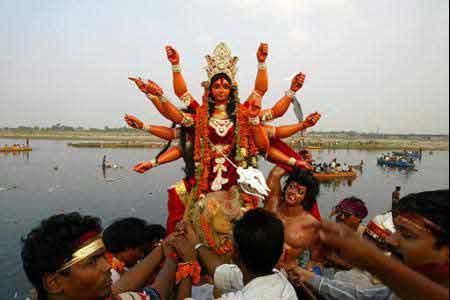
    • Immersion of Idols in Ganga | গঙ্গাএ মূর্তি  বিসর্জন
      • The annual ritual of immersion of Idols of Hindu deities like Durga during Durga Puja (দুর্গা পুজো), which is the main festival of Indian Bengal and several others idols during the course of the year, increases the pollution in the already polluted river, and also causes the deposition of silt .
      • Immersion of Idols has also threatened the survival of the Gangetic Dolphin and other aquatic creatures.
  
Immersion of Idols in Ganga | গঙ্গায় মূর্তি বিসর্জন

    • Humans ritually bathe themselves in the waters adding to the pollution.  [Maximum in Varanasi (বেনারস) approx 60,000 devotees ritually bathe every morning!]
    • The Sacred practice of depositing human remains, scattering of the ashes after cremation in the Ganga also poses serious threat to the ecosystem because of the dumping of partially cremated corpses, and there are people who can't afford to cremate their loved ones - so they simply throw the dead body directly into the river.
    • Hundreds of corpses burn on the wooden pyres on the bank of the river, then at times these still-glowing ashes, garlands etc are swept into the river.
    • In addition to this, the dead bodies and remains of several animals which are sacred to the Hindus are also dumped in the Ganges.
    • People come to the banks and throw away bags full of “Pooja Flowers” into the river, making the river a “Sewage Canal”!
    • Then these ashes, mixed with flowers/garlands, polythene bags, empty cans and foam resurfaces and floats atop the waves.
  • Irrigation & Agriculture
    • Agricultural runoffs  in the Ganga basin, which is mixed with chemical fertilizers, harmful pesticides like DDT (BANNED IN UNITED STATES) etc directly into the river causing threat to the aquatic creatures and contaminating the underground water.
    • Captivating the river water by creation of Dams or diverting the river water, mainly for irrigation purposes also causes pollution.
  • Pollution, directly by citizens :
People washing clothes & bathing at Dakhineshwar ghat
    • Washing of Clothes & Bathing of cattle:-Thousands of people wash clothes, with detergents etc directly on the river banks adding to the pollution. Apart from humans bathing, you can also see people bathe their cattle in the river!
    • Its not an uncommon sight to see a passerby jus throwing a Polythene Bag full of Garbage into the River.
All the above mentioned factors as well as deforestation, unplanned urbanization as well as several other factors have rendered the water of Ganga unfit for bathing or drinking!

II. Effects of Pollution in Ganga

  • People are facing health problems and diseases like:
    • Typhoid
    • E-coli
    • Tuberculosis
    • Gastrointestinal bleeding and other water borne diseases.
  •  They are getting infected by:
    • Bathing
    • Drinking
    • Cooking
    • Washing clothes and due to staying in direct contact wit the polluted river water.
  • Contamination of the Underground Water- due to presence of chemical fertilizers, harmful pesticides and other toxins in the river water. Presence of high levels of Arsenic has been detected in the ground water in several areas along the Ganga basin.
  • The Gangetic Dolphin, with an approximate population of 2000 has become an endangered species.
  • The fishes in the Ganga River are striving hard for survival; toxins are entering their tissues which are then consumed by humans and thus, indirectly the toxins are entering our bodies.

River Ganga (Padma) dried up & reduced to a 6ft
wide shallow stream during summer season in Rajshahi,
Bangladesh.
Farraka Barrage effect !
[Picture by: Donald Katz http://donnybangla.blogspot.com]

A stabilized river bank near Diamond Harbor,Kolkata.
But,Still the port remains unnavigable for Large Ships due to silting.


III. What can be done to SAVE Ganga?

  • The First and foremost thing is Awareness among the people about the ill effects of polluting the Ganga!
    • General public should refrain from :-
      • Bathing,
      • Washing clothes,
      • Cleaning vehicles,
      • Open defecation (Shitting) in the river banks!
      • Throwing garbage, polythene bags, pooja flowers in the Ganga.
  • Dumping of sewage and industrial effluents should be completely banned and strictly implemented. Sewage treatment plants (STP’s) are must along the river bank.
    • Sewage treatment through the Pond system [Advanced integrated wastewater oxidization pond system] should be preferred over the electricity- dependent method.
  • Improvisation of Solid Waste Management System required for preventing dumping of solid wastes in the river.
  • Artificial Water-bodies (Tanks) should be constructed for immersion of idols, else a day will come when there will be absolutely no water in the Ganga! Then where will they immerse idols???
    • The Kolkata High Court on October 5, 2010 directed that the guideline framed by the West Bengal Pollution Control Board (WBPCB) will have to be followed for cleaning up the river Ganga after immersion of idols. The court also said that it was the duty of Kolkata Port Trust (KPT) and concerned municipalities to clean the river after idols immersion.
    • কলকাতা হাইকোর্ট এবং দূষণ নিয়ন্ত্রণ পরিষদের নির্দেশিকা অনুযায়ী পুজোর ফুল, চালচিত্র, ঘট ইত্যাদি এবার গঙ্গায় বিসর্জন দেওয়া যাবে না। ঘাটের পাশেই তৈরি হয়েছে আলাদা ভ্যাট, সেখানেই ফেলে দিতে হবে পুজোর উপাচার। গঙ্গাদূষণ রোধে পুরসভা চেষ্টা করবে বিসর্জনের ২৪ ঘন্টার মধ্যে জল থেকে কাঠামোগুলি তুলে ফেলা যায়But this is not going to serve any good! We have to consider other alternatives and strictly stop immersing idols in Ganga!
    • This is a very sensitive issue and people should try to understand it logically, the ill effects of immersing idols in the Ganga.
  • Use of Bio-gas/Electrical crematoriums should be promoted and cremating in open air and on the banks of the river should be avoided.
 
Left: An improvised river bank in Europe, with green pasture and a walkway.
Right: Ganga river bank in pathetic condition. 

  • River banks should be improvised to reduce erosion by construction of Levee and Revetments.
  • Afforestation, by creating avenues/green pastures along the river banks.
  • The use of highly dangerous and non-biodegradable chemical fertilizers and pesticides like DDT etc should be strictly banned. Use of bio-fertilizers should be promoted.
It is said that “The character of a city is best judged by how well it maintains its sea or river front.”


One of the Cleanest patches of the Ganga River.
Our national river, Ganga is dying. What will happen when the river begins to dry up? If Ganga becomes a stream of sewage and toxins, Bangladesh along with India will suffer, as Ganga will no longer be able to support neither the economy nor the people of the two nations. If we do not succeed in a determined effort to save Ganga, we are risking the right of our future generations to a healthy, life-enhancing environment.


Sunday, January 16, 2011

Ban Bandhs in Bengal


It’s been almost 64 years since India got it’s independence from the British and the western part of Bengal province took its shape as West Bengal state of Indian Union. Since then it wasn’t a smooth way for West Bengal, as it had lost all the jute growing areas to East Bengal and was left with only the jute mills which had no raw materials! Still then Bengal picked up pace and West Bengal was India’s pre-eminent industrial state, with highest per capital real GDP among other states in the 1950’s.

Then shutting down of factories/jute mills etc led to frequent strikes (Bandhs) in Bengal (Bn: বাংলা বন্‌ধ)  . Bandhs were called by all the political parties to show their power. As a result it was the general public who were suffering due to these Bandhs and the State’s image was severely hampered internationally as well as nationally. It had somewhat become a synonym i.e. B for Bengal and B for Bandhs!

Road blockage during a Bandh [courtesy: Bengalnewz]- 
The Bandhs disrupt normal public life by forcefully shutting down all business establishments like shops, malls, multiplexes, Offices causing huge losses to the business.
Due to forcefully disrupting transport services (busses, trams, rickshaws, taxis etc they not only led to a tangible loss of hundreds of crores of rupees a day, but an equally massive intangible loss by way of a damage to the state’s image and negative signals to potential investors..!

Bengal is the state with maximum bandhs in India, where the average number of bandhs per year is 40-50 (ranging from a couple of hours to a maximum of 2 days per bandh). This is one of the main reasons why people from other states and other countries have a negative image about state of affairs in Bengal.

The political parties in Bengal need to realize:

  • What message they are sending to the International and the Indian business community by intimidating and forcing people to stop their work...!
  • Bandhs are not solution to any problem it only cripples the state and leads to deterioration of the prevailing conditions.
  • Instead, the state should make more efforts to attract investors as Bengal suffers from poor infrastructure thus they need investment in infrastructure —- multilane highways, overpasses, bridges and additional ports. They can achieve this if and only if they SCRAP the “BANGLA BANDH” CULTURE!
  • The government should stress on the Tourism industry too! Bengal has a large number places with historic importance and is also a treat for nature lovers.
Some of the Eminent Personalities of India INC criticizing Bangla Bandhs:
(Source- Economic Times )
·               Birla group of companies chairman B K Birla warned: “It’s very unfortunate to have strikes and lockouts. It doesn’t help anyone in the long run. On the contrary, it will have an impact on the state’s economy.”

·               RPG vice chairman Sanjiv Goenka virtually seconded the Birla patriarch’s emotions. “Anything that disrupts normal life and activity should not be encoraged. I personally don’t subscribe to the bandh as a means of protest,” he said.

·               Leading academics in the city seemed equally dis-enchanted by the latest turn of events and minced no words. For instance, Prof Anindya Sen, Dean, programme initiatives at IIM (C) said: “I’m utterly shocked and dismayed. Whatever the reason, we simply cannot afford to go on having bandhs every other day. It’s disastrous for the whole economy. At one level, it’s like the whole situation has been reduced to a game of one-upmanship. So, if somebody calls a 24-hour bandh one day, another goes a step further and calls a 48-hour bandh. What’s next? An indefinite bandh? Elaborating, the IIMC Dean said: “People are getting fed up now, which is why many are braving these bandhs and going to work. Besides, the ruling party has now called for a dialogue, and even third-party intervention. There’s no point in such frequent attempts to shut down the city. The atmosphere is just not conducive for work. People can’t go on functioning like this.”

·               S.K. Khullar, president, HRAEI (Hotel & Restaurant Association of Eastern India) said: “There have already so many bandhs in a row: one total and two partial recently, and things really can’t go on this way. For one, the hotel and restaurant industry suffers great losses, anything between Rs 30-40 crore for a total bandh. And even for the partial ones, sales are only half of a regular day’s. What’s more, it’s not just restaurants which suffer, but also the little street side stalls, which are deprived of a day’s earnings.”


Telegraph's Truth Test about The Bandhs on the People at Power !
It’s also the responsibility of common public living in Bengal to demonstrate against these “Bangla Bandhs” and irrespective of the political party calling the Bandh!


The youth should also understand the ill effects of these Bandhs on their future and criticize Bandhs instead of playing Street Soccer / Cricket!

We want development, and we want a progressive change in Bengal – we want a progressive & Bandh free Bengal!


We have a lot of hope from the new Government, we want to see the change in the attitude of the people in power. Work for more.. say no to Strikes.!


আমরা বন্ধ মুক্ত বাংলা চাই , আমরা প্রগতি চাই !
We HATE BANDHS!