Monday, April 18, 2011

Stop Wall Writings !


Wall Writing: Graffiti
Graffiti on  a wall near Kolkata Station | কলকাতা রেল স্থানকের কাছে দেওয়াল লেখন
This one on Strand Road reads, " Brigade Cholun" | স্ট্রান্ড রাস্তা
Wall writing or graffiti in West Bengal is mainly done by all the political parties to promote their candidates and for other political issues like "call for strikes (bandhs/hartals)" etc. Wall writing is like  a nightmare to the people of Bengal. All the political parties in Indian/West Bengal are insensitive towards this defacement of private and public property. Suppose you get your house painted with plush colors today, there are very good chances that tomorrow you'l see the sentence reading “এই চিনহে ভোট দিন” (Ei Chinhe Vote Din) Vote For this Symbol/Political Party on your newly painted wall. Moreover you realize that no one took your permission to do so- but you can’t complain either else you will be subjected to Harassment! This is the harsh reality in West Bengal today!

We can bring a change if we are united, a single person raising voice against this would get him into trouble but if all the residents decide to oppose it then they (Political Parties) are bound to stop this shit!

Another Dirty Wall! [courtesy Flickr photosream of toasterhead]
Look at our Bengal, such disgraceful & filthy wall writing/graffiti has brought shame to our state…! Its not that wall graffiti is seen only in Bengal; but its 500 times more than any other Indian state.  Tourists visiting West Bengal are stunned by the dirty graffiti-plastered walls, forget about the creepy hoardings including the "latest FLEX banners" they are a menace too, they (tourists) carry this image of Bengal; what a shame!

Against GraffitiRecently, I came across an article by Amartya Mukhopadhya in the Ananda Bazar Patrika news daily named:"দেওয়াল 'নিষ্কলঙ্ক' রাখার হ্যাট্রিক করলেন বাসিন্দারা" ("Residents successful in maintaining dignity of walls")  in which shows how the residents of Orient Row, Talbagan lane in Park Circus area of Kolkata have united against the wall graffiti and have been successful in keeping their walls free from graffiti! They have won against the hooliganism of the political parties by clearly stating that “Wall writing in this area will not at all be tolerated; Whoever fails to follow this dictat (ফতোয়া) wil not be voted at all! “

We, the common people of Bengal, do not like graffiti and we will not tolerate any attempt to deface our walls. We want our Bengal to be clean. Let’s send this bold message to All the Political Parties in Bengal- “If you want our votes - Stay Away From Our Walls!”


Tuesday, March 22, 2011

Save Ganga


Ganga River | গঙ্গা নদি
Ganga (Bangla: গঙ্গা), the National River of India (Bangla: ভারতীয় প্রজাতন্ত্রের জাতীয় নদী) originates from the Gangotri glacier of the Himalayas (Bangla:হিমালয়ের গঙ্গোত্রী হিমবাহ) in Uttarakhand, India, down the mountains, and across the one of the world’s densely populated plains to the Bay of Bengal (Bangla: বঙ্গপ মহাসাগর), the Ganges River is one of the world’s greatest rivers supporting millions of people with water and fertile soil for agriculture in India (Bangla: ভারত) and Bangladesh (Bangla: বাংলাদেশ).

Ganga River at its BEST ! Diamond Harbor
Even after being the National river of India and one of the most important river of Bangladesh, Ganga River is one of the dirtiest rivers in the world and on the verge of extinction. The river starts getting polluted as soon as it enters the densely populated Gangetic plains. The main branch of the Ganga passes through the Farraka Barrage (Bangla: ফারাক্কা বাঁধ) into Bangladesh and is known as Padma (Bangla: পদ্দা); this massive barrier diverts the water of the Ganga into the Hoogly (Bangla: হুগলী) branch which flows through Indian Bengal / West Bengal (Bangla: ভারতীয় বঙ্গ / পশ্চিমবঙ্গ).


Ganga in Indian Bengal

The Ganga River’s water which reaches Bengal has already been polluted during its flow through the northern states of India and it gets further polluted in Bengal before opening up into the Bay of Bengal.

I. The Factors Polluting Ganga:
  • Industrial Effluents
    • Polluted waste water flows into the Ganges river
    • The branch of Ganga River has numerous paper, pulp, jute and other industries lined along its banks. These industries discharge effluent into the river. This hazardous waste includes dark brown, oxygen-craving slurry of bark and wood fiber, hydrochloric acid, mercury and other heavy metals, pesticides, and polychlorinated biphenyls highly toxic compounds which accumulate in fish tissues, and chemical toxins like bleaches and dyes, which produce dioxin and other persistent compounds.
  • Sewage Discharge
    • One of the primary causes of pollution i.e. domestic sewage from cities and towns, treated or untreated should not be discharged into the Ganges.
    • Today Conservative estimates put the sewage flowing into Ganga at approximately 1 billion litres per day, of mostly untreated raw sewage.
    • Due to this, Fecal coliform measurements of the river have been recorded as high as 6,000 times the safe level for humans. (Fecal coliform is a bacterium found in the intestinal system of warm-blooded animals; their presence in large numbers indicates pollution by sewage contamination.)
  • Religion Vs Ganga’s Water Pollution
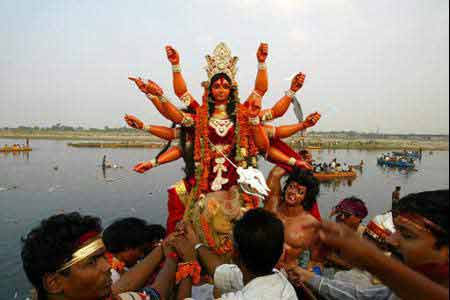
    • Immersion of Idols in Ganga | গঙ্গাএ মূর্তি  বিসর্জন
      • The annual ritual of immersion of Idols of Hindu deities like Durga during Durga Puja (দুর্গা পুজো), which is the main festival of Indian Bengal and several others idols during the course of the year, increases the pollution in the already polluted river, and also causes the deposition of silt .
      • Immersion of Idols has also threatened the survival of the Gangetic Dolphin and other aquatic creatures.
  
Immersion of Idols in Ganga | গঙ্গায় মূর্তি বিসর্জন

    • Humans ritually bathe themselves in the waters adding to the pollution.  [Maximum in Varanasi (বেনারস) approx 60,000 devotees ritually bathe every morning!]
    • The Sacred practice of depositing human remains, scattering of the ashes after cremation in the Ganga also poses serious threat to the ecosystem because of the dumping of partially cremated corpses, and there are people who can't afford to cremate their loved ones - so they simply throw the dead body directly into the river.
    • Hundreds of corpses burn on the wooden pyres on the bank of the river, then at times these still-glowing ashes, garlands etc are swept into the river.
    • In addition to this, the dead bodies and remains of several animals which are sacred to the Hindus are also dumped in the Ganges.
    • People come to the banks and throw away bags full of “Pooja Flowers” into the river, making the river a “Sewage Canal”!
    • Then these ashes, mixed with flowers/garlands, polythene bags, empty cans and foam resurfaces and floats atop the waves.
  • Irrigation & Agriculture
    • Agricultural runoffs  in the Ganga basin, which is mixed with chemical fertilizers, harmful pesticides like DDT (BANNED IN UNITED STATES) etc directly into the river causing threat to the aquatic creatures and contaminating the underground water.
    • Captivating the river water by creation of Dams or diverting the river water, mainly for irrigation purposes also causes pollution.
  • Pollution, directly by citizens :
People washing clothes & bathing at Dakhineshwar ghat
    • Washing of Clothes & Bathing of cattle:-Thousands of people wash clothes, with detergents etc directly on the river banks adding to the pollution. Apart from humans bathing, you can also see people bathe their cattle in the river!
    • Its not an uncommon sight to see a passerby jus throwing a Polythene Bag full of Garbage into the River.
All the above mentioned factors as well as deforestation, unplanned urbanization as well as several other factors have rendered the water of Ganga unfit for bathing or drinking!

II. Effects of Pollution in Ganga

  • People are facing health problems and diseases like:
    • Typhoid
    • E-coli
    • Tuberculosis
    • Gastrointestinal bleeding and other water borne diseases.
  •  They are getting infected by:
    • Bathing
    • Drinking
    • Cooking
    • Washing clothes and due to staying in direct contact wit the polluted river water.
  • Contamination of the Underground Water- due to presence of chemical fertilizers, harmful pesticides and other toxins in the river water. Presence of high levels of Arsenic has been detected in the ground water in several areas along the Ganga basin.
  • The Gangetic Dolphin, with an approximate population of 2000 has become an endangered species.
  • The fishes in the Ganga River are striving hard for survival; toxins are entering their tissues which are then consumed by humans and thus, indirectly the toxins are entering our bodies.

River Ganga (Padma) dried up & reduced to a 6ft
wide shallow stream during summer season in Rajshahi,
Bangladesh.
Farraka Barrage effect !
[Picture by: Donald Katz http://donnybangla.blogspot.com]

A stabilized river bank near Diamond Harbor,Kolkata.
But,Still the port remains unnavigable for Large Ships due to silting.


III. What can be done to SAVE Ganga?

  • The First and foremost thing is Awareness among the people about the ill effects of polluting the Ganga!
    • General public should refrain from :-
      • Bathing,
      • Washing clothes,
      • Cleaning vehicles,
      • Open defecation (Shitting) in the river banks!
      • Throwing garbage, polythene bags, pooja flowers in the Ganga.
  • Dumping of sewage and industrial effluents should be completely banned and strictly implemented. Sewage treatment plants (STP’s) are must along the river bank.
    • Sewage treatment through the Pond system [Advanced integrated wastewater oxidization pond system] should be preferred over the electricity- dependent method.
  • Improvisation of Solid Waste Management System required for preventing dumping of solid wastes in the river.
  • Artificial Water-bodies (Tanks) should be constructed for immersion of idols, else a day will come when there will be absolutely no water in the Ganga! Then where will they immerse idols???
    • The Kolkata High Court on October 5, 2010 directed that the guideline framed by the West Bengal Pollution Control Board (WBPCB) will have to be followed for cleaning up the river Ganga after immersion of idols. The court also said that it was the duty of Kolkata Port Trust (KPT) and concerned municipalities to clean the river after idols immersion.
    • কলকাতা হাইকোর্ট এবং দূষণ নিয়ন্ত্রণ পরিষদের নির্দেশিকা অনুযায়ী পুজোর ফুল, চালচিত্র, ঘট ইত্যাদি এবার গঙ্গায় বিসর্জন দেওয়া যাবে না। ঘাটের পাশেই তৈরি হয়েছে আলাদা ভ্যাট, সেখানেই ফেলে দিতে হবে পুজোর উপাচার। গঙ্গাদূষণ রোধে পুরসভা চেষ্টা করবে বিসর্জনের ২৪ ঘন্টার মধ্যে জল থেকে কাঠামোগুলি তুলে ফেলা যায়।But this is not going to serve any good! We have to consider other alternatives and strictly stop immersing idols in Ganga!
    • This is a very sensitive issue and people should try to understand it logically, the ill effects of immersing idols in the Ganga.
  • Use of Bio-gas/Electrical crematoriums should be promoted and cremating in open air and on the banks of the river should be avoided.
 
Left: An improvised river bank in Europe, with green pasture and a walkway.
Right: Ganga river bank in pathetic condition. 

  • River banks should be improvised to reduce erosion by construction of Levee and Revetments.
  • Afforestation, by creating avenues/green pastures along the river banks.
  • The use of highly dangerous and non-biodegradable chemical fertilizers and pesticides like DDT etc should be strictly banned. Use of bio-fertilizers should be promoted.
It is said that “The character of a city is best judged by how well it maintains its sea or river front.”


One of the Cleanest patches of the Ganga River.
Our national river, Ganga is dying. What will happen when the river begins to dry up? If Ganga becomes a stream of sewage and toxins, Bangladesh along with India will suffer, as Ganga will no longer be able to support neither the economy nor the people of the two nations. If we do not succeed in a determined effort to save Ganga, we are risking the right of our future generations to a healthy, life-enhancing environment.


Sunday, January 16, 2011

Ban Bandhs in Bengal


It’s been almost 64 years since India got it’s independence from the British and the western part of Bengal province took its shape as West Bengal state of Indian Union. Since then it wasn’t a smooth way for West Bengal, as it had lost all the jute growing areas to East Bengal and was left with only the jute mills which had no raw materials! Still then Bengal picked up pace and West Bengal was India’s pre-eminent industrial state, with highest per capital real GDP among other states in the 1950’s.

Then shutting down of factories/jute mills etc led to frequent strikes (Bandhs) in Bengal (Bn: বাংলা বন্‌ধ)  . Bandhs were called by all the political parties to show their power. As a result it was the general public who were suffering due to these Bandhs and the State’s image was severely hampered internationally as well as nationally. It had somewhat become a synonym i.e. B for Bengal and B for Bandhs!

Road blockage during a Bandh [courtesy: Bengalnewz]- 
The Bandhs disrupt normal public life by forcefully shutting down all business establishments like shops, malls, multiplexes, Offices causing huge losses to the business.
Due to forcefully disrupting transport services (busses, trams, rickshaws, taxis etc they not only led to a tangible loss of hundreds of crores of rupees a day, but an equally massive intangible loss by way of a damage to the state’s image and negative signals to potential investors..!

Bengal is the state with maximum bandhs in India, where the average number of bandhs per year is 40-50 (ranging from a couple of hours to a maximum of 2 days per bandh). This is one of the main reasons why people from other states and other countries have a negative image about state of affairs in Bengal.

The political parties in Bengal need to realize:

  • What message they are sending to the International and the Indian business community by intimidating and forcing people to stop their work...!
  • Bandhs are not solution to any problem it only cripples the state and leads to deterioration of the prevailing conditions.
  • Instead, the state should make more efforts to attract investors as Bengal suffers from poor infrastructure thus they need investment in infrastructure —- multilane highways, overpasses, bridges and additional ports. They can achieve this if and only if they SCRAP the “BANGLA BANDH” CULTURE!
  • The government should stress on the Tourism industry too! Bengal has a large number places with historic importance and is also a treat for nature lovers.
Some of the Eminent Personalities of India INC criticizing Bangla Bandhs:
(Source- Economic Times )
·               Birla group of companies chairman B K Birla warned: “It’s very unfortunate to have strikes and lockouts. It doesn’t help anyone in the long run. On the contrary, it will have an impact on the state’s economy.”

·               RPG vice chairman Sanjiv Goenka virtually seconded the Birla patriarch’s emotions. “Anything that disrupts normal life and activity should not be encoraged. I personally don’t subscribe to the bandh as a means of protest,” he said.

·               Leading academics in the city seemed equally dis-enchanted by the latest turn of events and minced no words. For instance, Prof Anindya Sen, Dean, programme initiatives at IIM (C) said: “I’m utterly shocked and dismayed. Whatever the reason, we simply cannot afford to go on having bandhs every other day. It’s disastrous for the whole economy. At one level, it’s like the whole situation has been reduced to a game of one-upmanship. So, if somebody calls a 24-hour bandh one day, another goes a step further and calls a 48-hour bandh. What’s next? An indefinite bandh? Elaborating, the IIMC Dean said: “People are getting fed up now, which is why many are braving these bandhs and going to work. Besides, the ruling party has now called for a dialogue, and even third-party intervention. There’s no point in such frequent attempts to shut down the city. The atmosphere is just not conducive for work. People can’t go on functioning like this.”

·               S.K. Khullar, president, HRAEI (Hotel & Restaurant Association of Eastern India) said: “There have already so many bandhs in a row: one total and two partial recently, and things really can’t go on this way. For one, the hotel and restaurant industry suffers great losses, anything between Rs 30-40 crore for a total bandh. And even for the partial ones, sales are only half of a regular day’s. What’s more, it’s not just restaurants which suffer, but also the little street side stalls, which are deprived of a day’s earnings.”


Telegraph's Truth Test about The Bandhs on the People at Power !
It’s also the responsibility of common public living in Bengal to demonstrate against these “Bangla Bandhs” and irrespective of the political party calling the Bandh!


The youth should also understand the ill effects of these Bandhs on their future and criticize Bandhs instead of playing Street Soccer / Cricket!

We want development, and we want a progressive change in Bengal – we want a progressive & Bandh free Bengal!


We have a lot of hope from the new Government, we want to see the change in the attitude of the people in power. Work for more.. say no to Strikes.!


আমরা বন্ধ মুক্ত বাংলা চাই , আমরা প্রগতি চাই !
We HATE BANDHS!